Journal · Art de vivre
The covered passages of Paris
The covered passages of Paris, from the galerie Vivienne to the passage Brady: glass roofs, mosaics and old-world shops, the finest arcades to wander through.
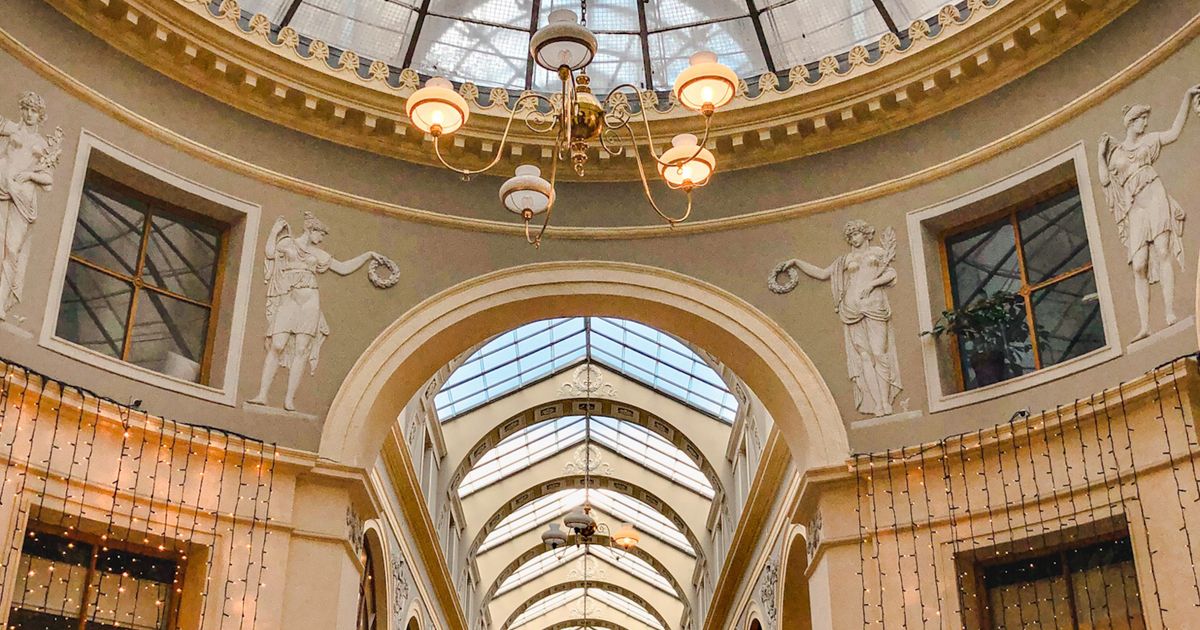
Before the department stores and the lit-up boulevards, Paris had invented another way to stroll: under cover, beneath glass roofs, between two rows of shop windows. In the early nineteenth century, the covered passages offered walkers shelter from the rain and the mud, a paved floor, overhead light and the new luxury of walking without haste. As many as a hundred and fifty were once counted; around twenty remain, like so many secret salons tucked into the heart of the buildings.
To push their doors open is to step into another era. Mosaic floors, painted wooden shopfronts, old booksellers, tea rooms, stamp dealers and cane makers: these galleries have kept the hushed charm of a bygone trade. Here are a few of the finest, to wander through slowly, eyes raised toward the light.
The galerie Vivienne, the most elegant
Opened in 1823, near the Palais-Royal, the galerie Vivienne is the queen of the Parisian passages. Its rotunda, its mosaics signed by Facchina and its arabesques make it a postcard setting. Here you find a renowned antiquarian bookseller, fashion boutiques, a tea room beneath the glass roof. The light falls with a particular softness, especially in the late morning.
Which is the elder of the Parisian passages?
Inaugurated in 1799, the passage des Panoramas is one of the oldest in Paris and the first to have been lit by gas. Today it beats to the rhythm of postcard and stamp collectors, whose shops sit alongside a row of small restaurants. The atmosphere is lively, almost popular, faithful to the spirit of its origins.
The passage Jouffroy, the theatre of the quarter
Just opposite, the passage Jouffroy (1846) was one of the first to be heated. Here you come across:
- The Hôtel Chopin, a charming hotel nestled at the far end of the passage since 1846.
- The entrance to the musée Grévin and its wax figures.
- A travel bookshop, a dealer in old canes and toys, a stationery boutique.
It is perhaps the most novelistic of the passages, with its nooks and its weathered signs.
The passage Verdeau and the galerie Véro-Dodat
In the continuation of the passage Jouffroy, the passage Verdeau (1846) draws lovers of engravings, old books and collectible cameras. Its chevron glass roof bathes the shops in a clear light, well suited to bargain hunting.
Further south, near the Louvre, the galerie Véro-Dodat (1826) composes one of the most refined settings in the capital: painted ceilings, columns, a marble chequerboard floor. Art galleries, furniture restorers and luxury houses keep up a discreet elegance there.
The passage du Grand-Cerf and the passage des Princes
Near the Montorgueil quarter, the passage du Grand-Cerf (1825) impresses by its height: nearly twelve metres beneath a generous glass roof. Designers, jewellers and decoration studios occupy shops flooded with light, in a resolutely contemporary atmosphere.
The passage des Princes (1860), one of the last to be built, was long the realm of toys. Its restored glass roof and its ironwork bear witness to the care given to these iron-and-glass architectures, heirs to the markets and railway stations of the period.
What scent of elsewhere in the passage Brady?
Further east, the passage Brady (1828) tells of another Paris. Nicknamed the “little India”, it lines up groceries, hair salons and restaurants from the Indian subcontinent and from Pakistan. Beneath its glass roof drifts a scent of spices that transports you in a few steps. It is proof that these galleries, two centuries on, remain living places, able to welcome new stories.
Which passage for which atmosphere?
The following table helps you choose according to the mood of the day:
| Passage | Period | Atmosphere |
|---|---|---|
| Galerie Vivienne | 1823 | Mosaics and classical elegance |
| Passage des Panoramas | 1799 | Postcard and stamp collectors |
| Passage Jouffroy | 1846 | Novelistic charm and collections |
| Passage Verdeau and galerie Véro-Dodat | 1846 and 1826 | Engravings, refined settings |
| Passage du Grand-Cerf and passage des Princes | 1825 and 1860 | High glass roof and designers |
| Passage Brady | 1828 | Spices and a scent of elsewhere |
How do you compose your walk, beyond the map?
These passages cannot be guessed from the street: you must know where to push the door, at what hour the light is most beautiful, which bookseller or which tea room deserves the detour. That is precisely what a dedicated contact cultivates: a fine knowledge of a discreet Paris, the one you will not find in the guidebooks.
At French Realty, this familiarity with the city is placed at the service of owners and residents, quoted individually, by the time actually spent. Composing an itinerary between two glass roofs, welcoming guests and showing them this hidden Paris: an attentive presence to make the most of the city, where others are content merely to pass through it. Our walk through literary Paris extends this one from bookseller to bookseller, the art of living category gathers the rest, and our guide to bespoke concierge services details what this presence changes.
Frequently asked questions
How many covered passages are left in Paris?
Paris once counted more than one hundred and fifty covered passages in the nineteenth century; around twenty remain, the best known clustered around the Palais-Royal and the Montorgueil quarter, on the Right Bank.
Which is the most beautiful covered passage in Paris?
The galerie Vivienne is often cited for its mosaics and rotunda; the passage des Panoramas charms with its collectors' atmosphere, the passage Jouffroy with its novelistic appeal. Each has its hour: the light of the glass roofs changes everything.
Where are the covered passages of Paris located?
Most are concentrated on the Right Bank, around the Palais-Royal, the boulevard Montmartre and the Montorgueil quarter, in the second and ninth arrondissements. The passage Brady, further east, brings a scent of spices and elsewhere.